
AGV and AMR?
AGV and AMR are both automated transport robots in factories and warehouses. However, these two technologies have many important differences.
What is AGV?
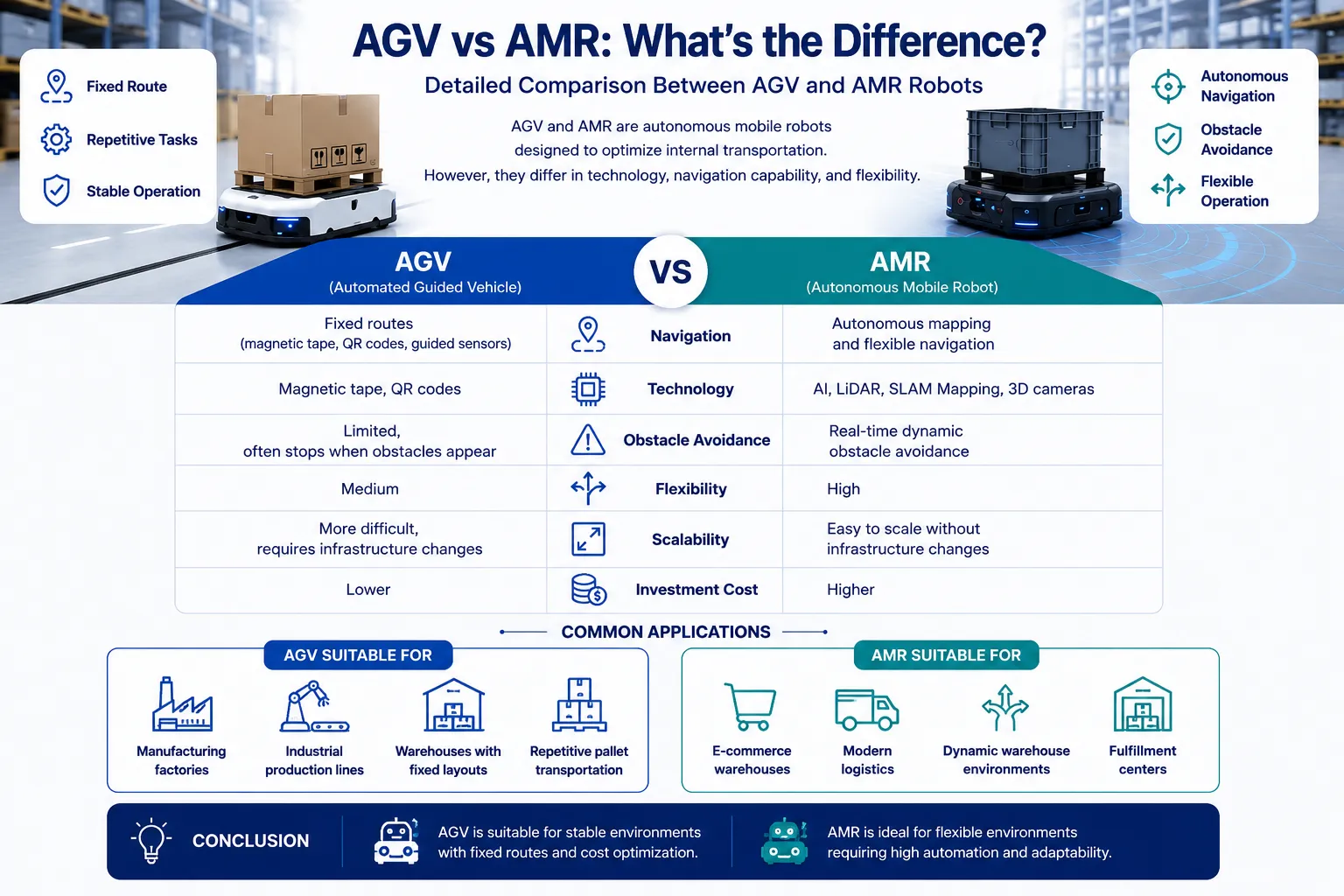
AGV (Automated Guided Vehicle) is an automated transport robot that operates along fixed, pre-programmed routes.
AGV robots typically use:
- Magnetic tape
- QR codes
- Navigation sensors
- Fixed tracks
To move within a warehouse or factory.
AGVs are commonly applied in:
- Production lines
- Industrial warehouses
- Factories with fixed layouts
- Internal pallet transport
The biggest advantages of AGVs are:
- Stable operation
- Easy control
- Lower investment cost compared to AMR
However, AGVs have limitations in flexibility when the environment changes frequently.

What is AMR?
AMR (Autonomous Mobile Robot) is an intelligent autonomous robot capable of:
- Self-positioning
- Self-mapping
- Route optimization
- Real-time obstacle avoidance
Unlike AGVs, AMRs do not require fixed routes but use:
- AI
- LiDAR
- 3D cameras
- SLAM Mapping
To move flexibly in dynamic environments.
AMRs are typically applied in:
- E-commerce warehouses
- Modern logistics
- Smart warehouses
- Environments with high traffic density
Thanks to their flexible adaptability, AMRs are becoming a new trend in warehouse automation.
When to Choose AGV?
AGV is suitable for:
- Fixed-route factories
- Environments with little change
- Repetitive processes
When to Choose AMR?
AMR is suitable for:
- Smart logistics
- Flexible factories
- Environments with many obstacles
Future Trends of Autonomous Robots
In the future, AMRs are predicted to grow strongly thanks to:
- AI
- Machine Learning
- Cloud Robotics
- IoT Integration
Robots will not only transport but also have the ability to:
- Optimize operations independently
- Analyze data
- Coordinate multiple robots
- Predict system failures
However, AGVs still play an important role in:
- Fixed production models
- Industrial plants
- Traditional automation lines
Therefore, AGV and AMR will coexist to serve different operational needs.